
The Badass Story of the Onna-bugeisha, the Women Samurai of Feudal Japan
Like many of women’s achievements throughout history, the story of the women samurai is buried under the notion that only men did things notable enough to be written down.
SPONSORED | Dead Pets is the podcast that celebrates the lives of the creatures who have changed ours. Listen to the latest episode below.
Like many of women’s achievements throughout history, the story of the women samurai is buried under the notion that only men did things notable enough to be written down.
A loooooong-ass time ago, Japan decided that having compulsory military service, which resulted in an army made up of farmers who would rather be tending their fields than storming into battle, wasn’t the best idea. At the same time, wealthy landowners in Japan needed skilled guards to protect their assets. You would think they would hire like a bouncer or two, but no. These guys built armies out of warriors for hire. Two of the most prominent landowning families with private armies decided to team up and take on the government. And wouldn’t you know it, they won! And so it was that the samurai class ruled Japan for the next 700 years.
Samurai not only had mad skills, but they had clout, too. They could hold public office, bear arms, and were socially superior to plebes. One couldn’t just become a samurai; one had to come from a samurai family. At age ten, children of the samurai class began their training in the art of all things badass—archery, sword fighting, horseback riding, and hand-to-hand combat.
They weren’t just skilled meatheads; they were also disciplined in military strategy, literature, and the arts.
Samurai adhered to a strict code called bushido, and fucking about was not an option. The tenets of bushido can be summed up as such: do not be an asshole.
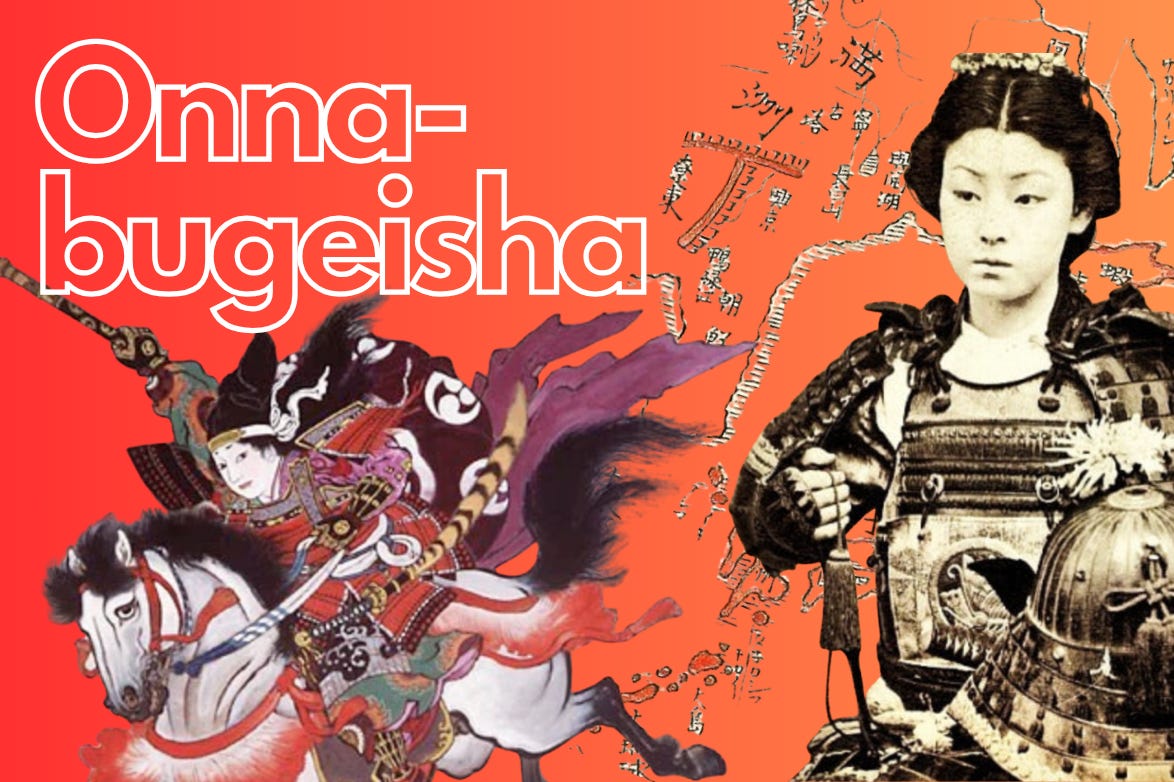
All people from the samurai class were technically samurai. Women were trained in the martial arts, typically to defend their homes rather than take up arms on the battlefield. Whether girls were trained as warriors depended on the family and sometimes the region. In Aizu, a region in northern Japan, women samurai were trained in the military arts equally to the men and were sworn to protect their domain, lord, and families. These women were known as the onna-bugeisha.
Nakano Takeko
Nakano Takeko was just 21 years old when the Imperial forces invaded Aizu in 1868. She came from a highfalutin samurai family, and from the time she was 12, she was trained in martial arts, calligraphy, and Confucianism.
Before the Imperial invasion, she taught the women and children at Aizuwakamatsu Castle how to use her favorite weapon, the naginata, a long pole with a wicked-sharp blade on the end. It’s also said that she frequently caught and punished perverts who would sneak into the women’s bathroom areas.
When Imperial forces invaded Aizu in October 1868, Nakano, her mother, and her sister formed a unit of women warriors, retroactively named the Joshitai (female army). At first, the women were told by some bro of a commander that their presence in battle could be perceived as weakness. Nakano was like, “Dude,” and threatened suicide. A new, more progressive commander intervened and said, “No need for theatrics, arm for battle, ladies.”
The women cut their hair, put on men’s clothing, and gathered their swords and halberds. Their enemy was armed with guns. They were under no illusion that they would survive the battle. It’s said that Nakano killed half a dozen men before she was shot in the chest. Not wanting to give the enemy the satisfaction of taking her head as a trophy, she asked her 16-year-old sister to behead her. Her request was obliged, and her head was buried with honor under a pine tree near her family’s temple.
The surviving Joshitai retreated to the castle during a 30-day siege. Over the next month, the wounded turned into the dead, and food dwindled to nothing. When a 60-year-old woman—which back then was sooooo goddamn old she might as well have been 250 years old—left the shelter of the castle to find food for the women, she was confronted by an enemy soldier. She did what a woman in her situation would do: she killed him and went along her merry way to find some groceries.
Gozen Tomoe
It’s debated whether Gozen Tomoe ever existed, as accounts of her life in historical records are sparse. But for our purposes, she does exist, and the myth that shrouds her name is, in fact, the whole truth and nothing but the truth.
Tomoe was a key figure in the Genpei War (1180–1185), a clan war between the Taira and Minamoto. She served under Yoshinaka Minamoto (aka Kiso) and is said to have been quite a talented beheader of men. She ascended to leadership, and in 1183, she led thousands of men to victory over the Taira at Tonamiyama. Like. A. Boss.
Tomoe fought by Kiso’s side until the last year of the war. At his urging, she left during battle when it was clear things were not going to end so hot for them. Before she fled, she set her sights on one man on the enemy side, a renowned samurai named Moroshige Onda. She charged straight for him, ripped him off his horse, and BOOM! Chopped his head off in one clean swipe. Must we say it? Slay, queen.
Legend has it that Tomoe lived to the ripe old age of 90.
Hangaku Gozen
Gozen was the daughter of a well-known military commander, Jo Sukenga. She was among the league of warriors who defended Torisaka Castle. When it came to archery, she was the number one diva, almost never missing her target. During a three-month siege of the castle, she unleashed hundreds of arrows into the flesh of approaching soldiers. Absolute legend.
Aika Teruko
Teruko was the granddaughter of Kaihime, a total babe who was known as the most beautiful woman in Japan. Her father was the lord of Tatebayashi Castle, and she was trained in the military arts from a young age.
Teruko married warlord Yura Shigeru, a clan leader and lord of Kanayama Castle. After Shigeru died of illness in 1578, their son, Kunishige, took over command of the clan, and Teruko became a nun. But Kunishige was kind of a moron and really fumbled the bag with the whole leading-the-clan thing. Teruko stepped in and said, “Let mama do it.”
In 1584, when she was 71 years old, Teruko commanded 3,000 soldiers in defense of Kanayama Castle when enemy troops marched against it.


